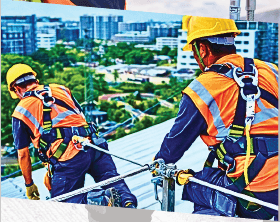
When we talk about working at heights, attention often focuses on visible equipment such as helmets, belts, and lanyards. But there is a fundamental element that often goes unnoticed: the lifeline.
Discreet in structure, decisive in safety.
Why is the lifeline so important?
The lifeline is a system designed to protect professionals exposed to fall hazards. Its function is simple but vital: to prevent an incident from turning into a tragedy.
More than a technical component, it represents an essential layer of protection in activities performed on roofs, facades, metal structures, and elevated areas.
Technical standards are not bureaucracy
In Brazil, fall protection systems are directly linked to standards such as NR-35 (Working at Heights) and specific technical guidelines.
These directives exist for a clear reason:
👉 Standardize procedures
👉 Reduce operational risks
👉 Ensure structural reliability
Following standards is not just about complying with rules — it is about adopting practices developed based on engineering, testing, and risk analysis.
Improper installation: a silent risk
A poorly designed or incorrectly installed lifeline can create a false sense of security.
Common problems include:
- Undersized anchorage points
- Fastenings incompatible with the structure
- Lack of technical inspection
- Absence of documentation and ART (Technical Responsibility Annotation)
In practice, this means that at the most critical moment, the system may fail to perform as it should.
Safety is design, not improvisation
The efficiency of a lifeline depends on three fundamental pillars:
✔ Proper technical design
Each structure has its own characteristics. The system must be sized considering loads, materials, and type of use.
✔ Professional installation
Fastenings, anchorages, and components must be carried out by qualified teams.
✔ Inspection and maintenance
Every safety system requires periodic verification to ensure performance over time.
Protection beyond the standard
Investing in a correctly installed lifeline system is not just a compliance measure.
It is a strategic decision that:
✅ Protects lives
✅ Reduces labor liabilities
✅ Minimizes operational interruptions
✅ Reinforces safety culture
Because, in the end, workplace safety is not a cost — it is a responsibility.