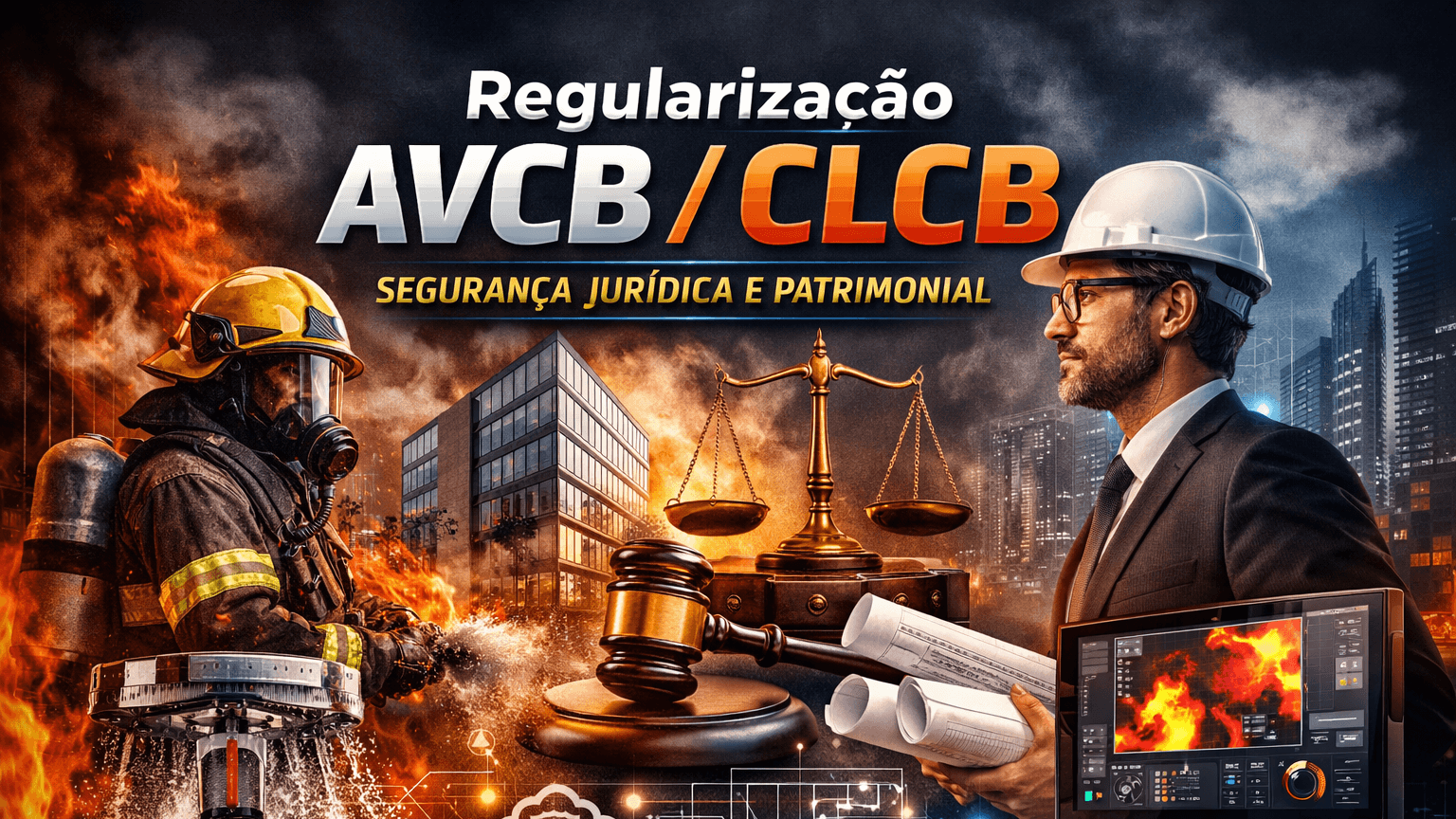
When you assess your company or property, what is really at stake? Physical structures... or the continuity of the business, asset protection, and people's safety?
It is still common for compliance with the Fire Department to be treated as a bureaucratic requirement. A cost. A document.
In practice, the AVCB (Fire Department Inspection Certificate) and the CLCB (Fire Department License Certificate) represent something much more critical: legal shielding, operational risk reduction, and preservation of strategic assets.
In this guide, we show why compliance is not just a legal demand — it is a smart business decision.
✅ 1. What are AVCB and CLCB — and why are they indispensable?
The AVCB and CLCB certify that the building complies with current fire safety regulations.
But the impact goes beyond compliance.
Asset Protection
A fire is not just a physical event — it is a potential financial, operational, and reputational collapse.
Legal Security
Without a valid certificate, the scenario in the event of an incident may include:
-
Refusal or limitation of insurance coverage
-
Civil liability
-
Exposure to administrative sanctions
-
Legal risks for managers and owners
Compliance is not a cost. It is risk management.
🧠 2. Engineering: the decisive factor in real protection
Improvised solutions create a false sense of security.
In fire protection, the difference between superficial compliance and effective safety is in the applied engineering.
Technical Responsibility (ART)
The Technical Responsibility Annotation formalizes something essential: there is a professional legally responsible for the implemented solutions.
This reduces legal exposure and eliminates technical decisions without normative backing.
Technical Precision = Financial Efficiency
Well-designed projects avoid:
-
Oversizing systems
-
Unnecessary corrective renovations
-
Rework during inspections
-
Hidden non-compliance costs
Good engineering does not increase costs. It prevents waste.
🚀 3. Fire Safety 4.0: protection beyond the visible
Technological evolution has transformed the prevention logic.
Today, intelligent systems allow early detection, quick response, and continuous monitoring.
Advanced Passive Protection
Intumescent coatings and structural solutions that increase fire resistance, preserving integrity and evacuation time.
Intelligent Detection
Sensors and thermal cameras capable of identifying critical variations before the risk becomes an event.
Remote Monitoring
Real-time supervision of hydraulic systems, alarms, and critical devices.
Modern safety is not just about reacting. It is about anticipating.
🏗️ 4. The path to efficient compliance
Effective compliance requires method, precision, and integrated technical management.
At Redax Engenharia, the process follows three pillars:
1️⃣ Diagnosis and Technical Project
Building analysis and PPCI development according to applicable standards.
2️⃣ Adjustments and Implementations
Structural corrections, system installations, and necessary operational adjustments.
3️⃣ Certification Process Management
Technical and documentary follow-up until the issuance of the AVCB or CLCB.
No improvising. No uncertainties. No rework.
⚖️ Safety is not optional. It is strategic.
Building or maintaining a property involves significant investments, planning, and long-term vision.
Ignoring technical safety requirements does not reduce costs — it only transfers risks to the future.
Fines, shutdowns, operational losses, and legal exposures are rarely unexpected events.
They are almost always avoidable consequences.
Shall we treat safety with the seriousness it requires?
Redax Engenharia operates with a focus on technical precision, regulatory safety, and sustainable asset protection.
If your goal is to protect assets, reduce risks, and operate with legal peace of mind, we are ready to support you.
📞 Talk to our specialists
(11) 99170-3802 / (11) 98492-0541
www.redaxengenharia.com.br
Osasco – SP
Redax Engenharia — Engineering that protects, regularizes, and builds trust.